LeanLeren
A Lean Six Sigma training platform for the Dutch B2B market. Multiplayer factory simulations a trainer runs live with a room of people.
The Problem
Lean Six Sigma is taught with physical props. Bricks on a table, paper aeroplanes, a bowl of beads. The exercises work. They teach batching, defects and flow better than any slide deck. But they only exist in a room, they need a trainer with a suitcase, and nothing that happens in them is measured. Move the training online and you usually lose the simulation entirely and get a quiz. I wanted the exercises intact, with the numbers captured.
What It Does
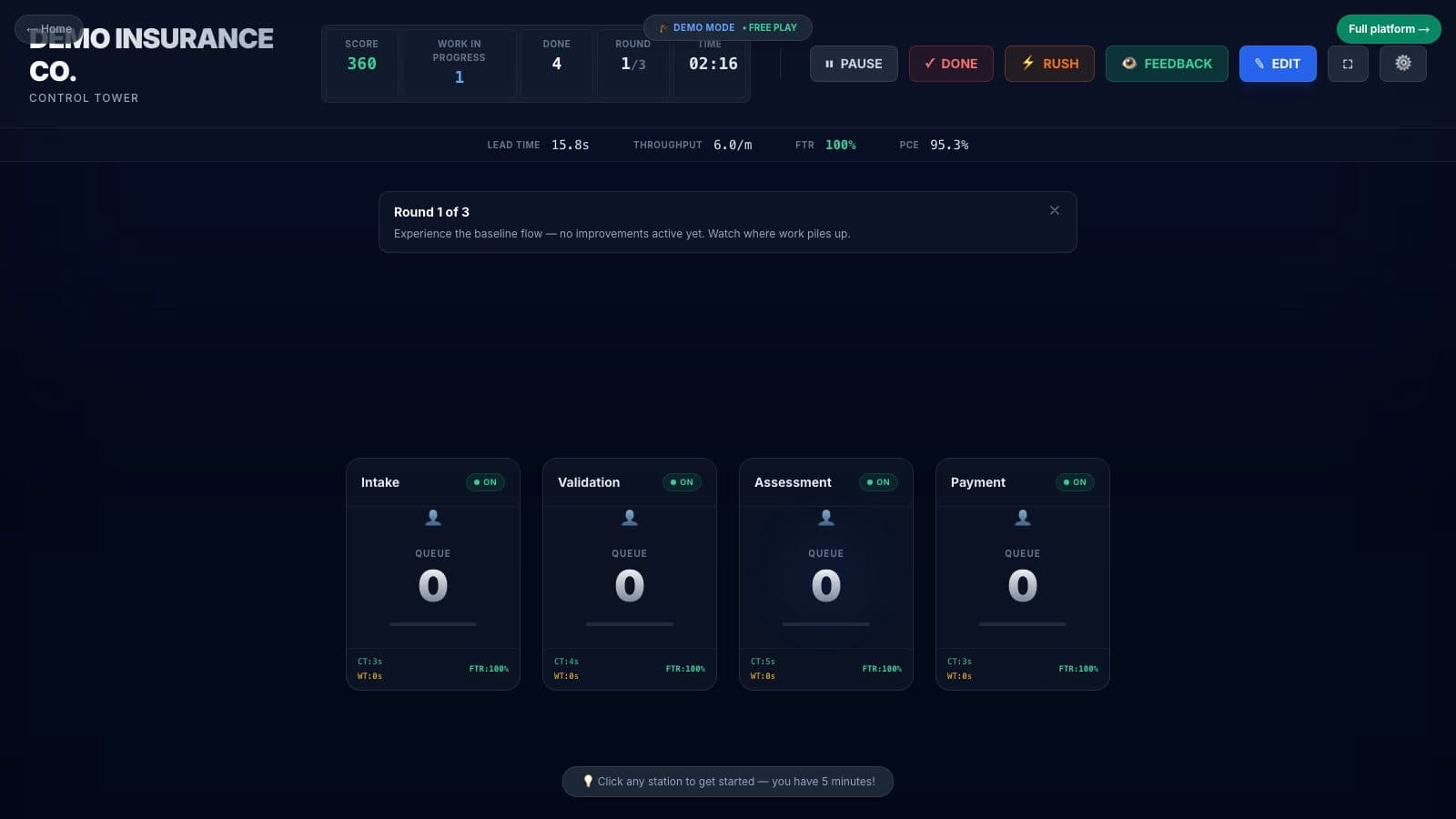
A trainer creates a session and a group joins it. Everyone takes a workstation on the same simulated production line, building brick cars, processing insurance claims, running a supply chain. The line behaves like a real one. Work queues up. Defects come back for rework. Round one goes badly on purpose. Between rounds the group looks at its own KPIs, argues about what went wrong, picks three improvements, and runs it again with the difference on screen.
Around that sits the boring half that makes it a business: trainers, organisations, training groups, belt levels from White to Black, downloadable templates rebranded with the client's own logo and colours, credits, contracts, invoices. Everything is in Dutch and English.
The hard part
A room of people running one production line at the same time, where the numbers at the end have to be defensible. That is the whole difficulty.
There are two obvious ways to build it and both are wrong. Compute every tick centrally and let the screens draw the result, and a factory floor feels like queuing at the post office. Let each screen work things out for itself, and it feels wonderful right up to the debrief, when the lines have quietly drifted apart and nobody's KPIs agree. The teaching only works if those numbers are real, so the choice was never really a choice: one version of the truth, and all the effort spent making deference to it feel instant.
Groups are also never the right size, so a short-staffed line still has to run as a full one. It's a web app in a monorepo, real-time multiplayer, with the debrief written from what the run actually produced.
Where It Stands
The August 2025 version sat untouched for four months before I threw it away and started again in December. After a quiet spring the work resumed, and it went straight back into the simulations rather than into anything commercial.
Built and deployed, in active development. The platform mechanics are largely done and the simulation library is still growing. Every so often I play the whole thing end to end as a trainer would, write an honest review of what doesn't hold up, and then fix it. Next is a live session in front of a real training room.
Next project
LifeTrack